Advancing training standardization, quality implementation, and professional development for the behavioral health workforce.
Core competencies define what practitioners must know and be able to do. To support training consistency, quality implementation, and professional development, BrainFutures has convened an interdisciplinary workgroup to identify a shared set of competencies for psychedelic therapy — foundational to work in both academic and clinical settings, and deliberately written to apply across an interdisciplinary care team rather than a single profession.
With regulatory approval anticipated in the near term, a skilled, established workforce must be ready to deliver safe, effective care. Core competencies build the shared lexicon and principles that a training and workforce architecture can be built on.
Core competencies are:
- Foundational to developing: curricula, training standards across disciplines, certification criteria
- Essential for ensuring: patient safety, consistency, quality and ethical delivery, reimbursement, coverage and ultimately access
- Useful for identifying: workforce readiness, coaching and mentoring frameworks
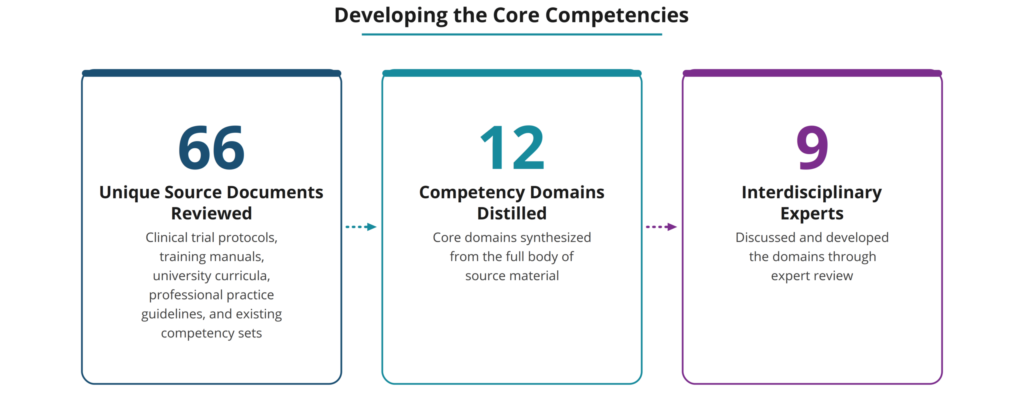
Each domain is analyzed for concordance — where the source literature agrees — and discordance, where the workgroup still needs to reconcile, choose, or clarify.
This process is led by an expert, interdisciplinary workgroup of expert stakeholders from academia, government, provider organizations, and patient advocacy organizations. The group will draw on existing research, established training curricula, and their own expertise to outline the skills and knowledge needed not only for direct care providers, but also for clinicians who counsel or refer patients to these services. After completion of the draft, the core competencies will be circulated for external review to ensure broad stakeholder representation and lay the groundwork for widespread adoption by providers, educators, and training programs. The workgroup will finalize its recommendations by late 2026 or early 2027.
The Core Competencies workgroup consists of:
- Heidi Allen, MSW, PhD – Professor, Columbia University in the School of Social Work and Mailman School of Public Health, Department of Health Policy and Management
- Jessica Jackson, PhD – Vice President of Alliance Development at Mental Health America
- Rick Lambert, MD – Senior Advisor, SAMHSA; Federal Liaison
- Vishal Madaan, MD, DFAPA, DFAACAP – Vice President, Chief of Education and Deputy Medical Director, American Psychiatric Association
- Paul Markham, PhD – Founder and Senior Partner at Sova
- L. Alison McInnes, MD – Director, Psychedelic Medicine, Mindful Health Solutions
- Andrew Penn, RN, NP, CNS, PMHNP-BC –Board certified psychiatric nurse practitioner; Director of Clinical Nursing Operations, Salma Health; Clinical Professor, University of California, San Francisco
- Stacey Pollack, PhD – Clinical psychologist; Senior Consultant for Strategic Priorities, Office of Mental Health (OMH), VA Central Office
- Leith States, MD – States Strategies
- Mary Elizabeth “Bit” Yaden, MD, MS, MAPP – Assistant Professor of Psychiatry, Johns Hopkins University, School of Medicine; Clinical Director, Center for Psychedelics and Consciousness ResearchThe Prescriber and Medical Oversight Subcommittee consists of:
The Prescriber and Medical Oversight Subcommittee consists of:
- Caroline Dorsen, PhD, FNP-BC, FAAN – Associate Dean for Clinical Faculty Affairs and Clinical Professor, NYU Rory Meyers College of Nursing; Senior Academic Advisor, Psychedelic Education Partnership (PEP)
- Neeraj “Jim” Gandotra, MD – Chief Medical Officer, SAMHSA; Federal Liaison
- Joseph Holshoe, PMHNP-BC – Psychiatric Nurse Practitioner; Owner, Tranquil Life Psychiatric Services; Medical Director, SARP, Naval Medical Center Portsmouth
- Jennifer Jones, MD – Assistant Professor of Psychiatry at the Medical University of South Carolina (MUSC)
- Jarret LeBeau, PharmD, BCACP – Clinical Pharmacist, Star Community Health; Clinical Assistant Professor, Temple University Lewis Katz School of Medicine
- Vishal Madaan, MD, FAPA, DFAACAP – Vice President, Chief of Education and Deputy Medical Director, American Psychiatric Association
- Jeffery Ramirez, PhD, PMHNP-BC, CARN-AP,CNE, FIAAN, FAANP, FAAN, Professor, School of Health Sciences, Department of Nursing at Gonzaga University
- William Sauvé, MD – Chief Medical Officer, Osmind
- Cody J. Wenthur, PharmD, PhD – Associate Professor, University of Wisconsin-Madison School of Pharmacy; Director of Graduate Studies, Psychoactive Pharmaceutical Investigation Programs
- Mary Elizabeth “Bit” Yaden, MD, MS, MAPP – Assistant Professor of Psychiatry, Johns Hopkins University, School of Medicine; Clinical Director, Center for Psychedelics and Consciousness Research
Related Work



 ® 2026 BrainFutures All Rights Reserved.
